
We Are All Americans
The Tragedy of Identity Politics in American History

Most college history courses have a common denominator: no matter the subject of the course, the syllabus will include one or more units devoted to race, gender and/or sexuality as they pertain to the course theme, even if they do not pertain to the course theme. The connection can be very forced, such as devoting a section of a Vietnam War class to the contributions of sexual minorities to the war. These topics are carved into every course in the name of inclusivity. The outcome of their “inclusion” is anything but. They serve only to divide and turn people against each other. The topics inevitably delve into how each group was oppressed and marginalized by the majority group. In this framework, these groups are cast as perennial outsiders with little to contribute to the national tapestry beyond their status as victims. When American History is taught and studied this way, it is a tragedy. History morphs from being a uniting force that brings people together around a shared story to just another vehicle of identity politics to sow discord, an attitude that is uniquely un-American. Unlike most countries where national inclusion is based on shared genetics, America is founded on a shared creed. To shift the focus from the creed to immutable characteristics is to abandon the heart of the American civilization.
Identity politics dragged into history is a tragedy for all involved, but ironically even more so for the group it seeks to promote. When history only focuses on how one class is oppressed by another, the oppressed group is cut off from the shared culture of the rest of the country. When, for example, academics put the focus in teaching the American Founding on the oppression of marginalized groups, as Jeffrey Anderson warns is taking place in the historic sites of Philadelphia, those groups have been cut out of the grander national story and relegated to a single unit on a college history syllabus. They are no more than the object of oppression of the majority, leaving them feeling bitter and isolated. They have nothing to celebrate on the 4th of July because they are told that the American story does not include them beyond their mistreatment. They are being robbed of the chance to celebrate and participate in what is true, good, and beautiful in their country’s history because they are convinced by the identity lens of history that the narrative is only the story of their oppression. Therefore, there is nothing worth celebrating. So far as such individuals embrace the identity narrative, they will restrict themselves from ever joining in the American story and participating in their country’s history in a meaningful way. Only by rejecting the identity obsession can those groups rise above petty oppression narratives and embrace what unites them with their countrymen.
The life of Ely Parker provides a powerful counterexample to the self-defeating identity lens. He had every reason to hate the United States but chose not to. He was born in Indian Falls, New York in 1828 on what was then the Tonawanda Reservation of the Seneca Indian tribe. His father had fought for the U.S. against the British in the War of 1812. When Parker attempted to do the same at the outbreak of the Civil War, he was rejected. He attempted to raise a regiment of his fellow tribesmen to serve in the Union Army, but was denied by the governor of New York. Parker appealed to Secretary of State William Seward, a fellow New York native. Seward told him that the war was “an affair between white men.” The Union Army had no place for Parker or anyone else who looked like him.
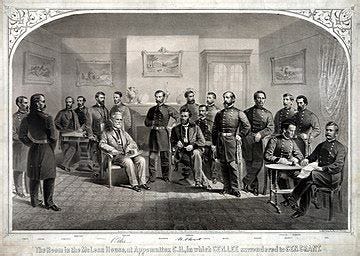
Parker did not grow bitter at his rejection. In today’s terms, that would be an understandable response. Help though came to him from an unlikely source. Working as an engineer before the war, he relocated to Illinois to serve on a Federal construction project. There he befriended a down on his luck shopkeeper in Galena, Illinois: Ulysses S. Grant. While Parker was denied entry into the Union Army, Grant had begun his own meteoric rise up the ranks due to his exploits in the war’s Western Theater. Grant’s recommendation helped his old friend into the army too. As an engineer by training, Parker proved himself invaluable to Grant at the pivotal Siege of Vicksburg, Mississippi in 1863. When Vicksburg fell to Grant’s army, the victory secured the entire Mississippi River for the Union, split the Confederacy in two, and allowed the Union Army to drive deep into the Lower South to cripple the Southern war effort. Parker would go on to work closely with Grant for the duration of the war. However, the culmination of Parker’s Civil War service came at Appomattox Courthouse. With the general staff in need of a steady hand to draft the surrender terms to Robert E. Lee, Parker the engineer was selected for the task.
Those who stir the cauldron of identity grievance would tell Ely Parker he ought to hate the United States. Had he listened, he would’ve cost himself the chance to play a beautiful role in the greater American story. Instead, Parker chose to love his country even when it did not love him. At Appomattox, Parker rejected bitterness towards his country that is so prevalent in the identity politics that infects history now. Instead, he exemplified to his countrymen a model of loving participation in the story of America. When Parker was introduced to Robert E. Lee, Lee remarked on Parker’s native ancestry that he was “glad to see one real American here.”
Parker replied, “We are all Americans here, sir.”
"Identity politics dragged into history is a tragedy for all involved, but ironically even more so for the group it seeks to promote. When history only focuses on how one class is oppressed by another, the oppressed group is cut off from the shared culture of the rest of the country. When, for example, academics put the focus in teaching the American Founding on the oppression of marginalized groups, as Jeffrey Anderson warns is taking place in the historic sites of Philadelphia, those groups have been cut out of the grander national story and relegated to a single unit on a college history syllabus. They are no more than the object of oppression of the majority, leaving them feeling bitter and isolated."
This is so true. If you go to Independence Hall, all they talk about it is how terrible the founding was the Founders were. They will even go so far as to claim that Samuel Adams was a slaveowner! That is one of the most bogus things I have ever heard (and I've heard a lot of bogus things)! The man was one of the most anti-slavery Founders we had!
But this is the very essence of Marxism. Oppressed and oppressor. They then get taught that the only way to not be oppressed is to overthrow the oppressor via revolution. This is Marxism in play.
Amazing article! Very knowledgeable!
"So far as such individuals embrace the identity narrative, they will restrict themselves from ever joining in the American story and participating in their country’s history in a meaningful way. Only by rejecting the identity obsession can those groups rise above petty oppression narratives and embrace what unites them with their countrymen."